Barbara Mandell Today I Started Loving You Again
| Barbara Mandrell | |
|---|---|
 Mandrell in 1991 | |
| Born | Barbara Ann Mandrell (1948-12-25) December 25, 1948 Houston, Texas, U.S. |
| Occupation |
|
| Years active | 1960 – 2000 |
| Spouse(s) | Ken Dudney (k. 1967) |
| Children | 3 |
| Relatives |
|
| Musical career | |
| Genres |
|
| Instruments |
|
| Labels |
|
| Associated acts |
|
| Website | barbara-mandrell |
Barbara Ann Mandrell (born Dec 25, 1948)[one] is an American country music vocaliser and musician. She is also credited as an actress and author. During the tardily 1970s and early 1980s, she was considered amongst state's virtually successful music artists. She had six number one singles and 25 top ten singles reach the Billboard land songs chart.[2] She also hosted her own prime–time tv set show in the early on 1980s that featured music, trip the light fantastic toe numbers and comedy sketches. Mandrell also played a variety of musical instruments during her career that helped bring a serial of major–industry awards.
Mandrell was born in Texas and raised more often than not in California. Raised by a musical family, she played an assortment of instruments by the time she reached her teenage years. Her skills on the steel guitar were noticed past state music entertainers, who gave Mandrell her first functioning opportunities at age 13. During this period she became a regular on the television program Town Hall Political party and performed as a musician in shows featuring Johnny Cash and Patsy Cline. Her family unit formed a band in her late teens which traveled overseas and entertained military machine bases. Afterward marrying in 1967, Mandrell nigh ended her performing merely ultimately decided to pursue a singing career instead. In 1969, she signed her first recording contract as a vocalist with Columbia Records.
In the early 1970s, Mandrell recorded a scattering of singles that fused land with R&B–soul. Her singles made the country charts with regularity. Her most successful of this menstruum was "Tonight My Baby's Coming Home" (1971) and "The Midnight Oil". In 1975, she moved to ABC–Dot records and reached her commercial breakthrough with country–pop singles similar "Sleeping Single in a Double Bed" (1978), "(If Loving Yous Is Wrong) I Don't Desire to Exist Correct" (1979), "I Was Country When Country Wasn't Cool" (1981) and "One of a Kind Pair of Fools" (1983). She became a headlining concert allure and won several major–industry awards including the Entertainer of the Year accolade from the Land Music Association.
After a 1984 machine accident, Mandrell most concluded her career. In 1985 she returned to recording and had several more acme ten land singles during the decade including "Fast Lanes and Country Roads" (1985), "No One Mends a Broken Heart Like You" (1986) and "I Wish I Could Fall in Love Today" (1988). She resumed performing, appearing alive in concert and acting on television receiver. Mandrell appeared in several television films and shows during the belatedly 1980s and 1990s like Burning Rage and Empty Nest. She continued recording into the 1990s, releasing several albums for the Capitol label including No Nonsense (1991). In 1997, Mandrell announced her retirement from performing and recording. She continued an acting career until 2000. In 2009, she was inducted into the State Music Hall of Fame for her work in the industry.
Early childhood [edit]
Mandrell was born in Houston, Texas.[iii] [iv] She was the eldest girl[three] born to parents Mary Ellen and Irby Mandrell.[five] The family later on moved to Corpus Christi, Texas where her father was a police force officeholder and her mother was a music teacher. Mandrell's two sisters, Irlene and Louise, were born in the city.[6] While in Corpus Christi, Mandrell got acquainted with music. She sang and played music regularly at habitation. She also recalled having a natural ear for hearing music. "I remember once I was at my cousins' habitation in Falfurrias. We were playing outside—and I'm talking this is when I'm a little daughter—and we were singing, of all things, 'I've Been Working on the Railroad.' All of a sudden I started to hear harmony. I began to sing it, and I just thought, 'This is the neatest affair in the world,'" she told Texas Monthly.[half dozen]
In her early childhood, she began performing publicly. Her first recollection of performing in front people was at her family'southward church singing a rendition of the "Gospel Boogie".[vii] In improver to singing, Mandrell as well learned several instruments as a small child. Mary Ellen Mandrell taught her daughter how to play the accordion and read music earlier she entering outset grade.[viii] [9] When she was six years quondam, the family moved to Oceanside, California.[6] Irby Mandrell opened his own music store.[ten] In her elementary schoolhouse years, she learned to play saxophone while a part of the schoolhouse band.[ix] During the same period, she started taking lessons on the steel guitar from her father's friend Norman Hamlet. Subsequently a year of practice on the musical instrument, Irby Mandrell took his daughter to a music trade testify in Chicago, Illinois. At the plan, she showcased her skills on the steel guitar. She was heard by state performer Joe Maphis who was impressed by the preteen. Maphis would assist launch Mandrell's early career as a musician.[x]
Music career [edit]
1960–1968: Late childhood and teenage years equally a steel guitarist [edit]
In 1960, Joe Maphis brought eleven-yr-onetime Mandrell onto his country music testify in Las Vegas, Nevada. Equally function of Maphis'due south act, she performed the steel guitar.[9] Maphis besides helped her secure a regular spot on the state music California television plan Town Hall Party.[10] [8] Feeling every bit if she was the only female musician, Mandrell discovered on Town Hall Party that other female instrumentalists also existed: "Men dominated the globe of country music, but I looked effectually and discovered there were more women than you might take thought."[seven] On summers off from school, Mandrell routinely went back to Las Vegas to perform.[xi] In 1962, she toured country music shows with artists Johnny Cash and Patsy Cline.[7] During the tour, xiii-yr old Mandrell shared hotel rooms with Cline since she was underage.[12] She as well performed steel guitar for Ruby-red Foley, Little Jimmy Dickens and Tex Ritter.[eleven]

As a teenager, Mandrell became skilled at the steel guitar and often played background for several country music artists.
When she turned 14, her parents formed the Mandrell Family unit Ring with Barbara on steel guitar, mother Mary Ellen on pianoforte and father Irby on lead vocals.[seven] They likewise hired two outside musicians including drummer Ken Dudney, whom Mandrell would afterward marry in 1967.[xiii] The Mandrell Family unit Band more often than not played war machine bases effectually the Usa and performed a variety of music including songs by The Beatles. While in the band, Mandrell besides took up the instruments banjo and bass guitar.[thirteen] [nine] Mandrell as well engaged in other activities during her teenage years. In 1965, she was voted "Miss Oceanside California".[fourteen] She participated in the marching band, chorus and pupil council. She eventually graduated from loftier schoolhouse in 1967.[7]
Shortly afterwards high schoolhouse graduation, Mandrell married Ken Dudney and chose to retire from performing to become a total-time housewife.[fifteen] [9] [4] Her last performance trip was to Vietnam where the Mandrell Family Band entertained the troops fighting in the Vietnam War.[7] Upon returning, Mandrell establish out that her husband had been sent temporarily overseas for his Navy pilot career. Feeling alone, Mandrell visited with her parents who had just moved to Nashville, Tennessee. There, the family unit attended a operation at the Yard Ole Opry.[13] While watching the show that evening, Mandrell realized that she still wanted to perform. "I wasn't cutting out to exist in the audience," she recalled in 2003.[16] With begetter Irby interim equally her manager[ix] she got the run a risk to play steel guitar on a show located in the Printer's Alley section of Nashville. In addition to the steel guitar, Mandrell also sang on several selections in the testify.[xv] Her skills as both a singer and musician caught the attention of six different record companies who offered her a recording contract. This included country music producer Baton Sherrill, who was watching the performance. In 1969, Mandrell signed with Sherill's label Columbia Records as a recording artist.[sixteen] [iv]
1969–1974: Singing transition and early success at Columbia Records [edit]
Mandrell started her singing career by cutting covers of R&B–soul selections.[17] [15] Her starting time Columbia single made America's Billboard country songs chart in 1969 chosen "I've Been Loving You Too Long (To Stop Now)".[eighteen] Information technology was a cover of the Otis Redding original.[fifteen] [4] It was followed past the Billy Sherrill-penned "Playin' Around with Love" (1970). Information technology became her beginning song to reach the meridian xx, peaking at number xviii on the Billboard land chart.[18] Her next singles were covers of Aretha Franklin's "Do Right Woman, Practice Correct Human" and Roy Head'southward "Treat Him Right".[4] [nineteen] In 1971, Mandrell'due south debut studio album was released through Columbia, also titled Care for Him Right. The disc included her charting singles between 1969 and 1971, along with covers of songs by Ivory Joe Hunter, Joe South and others.[20] Her early success garnered Mandrell the Top New Female Vocalist accolade from the University of Country Music in 1970[21] and a membership to the Grand Ole Opry in 1972.[15] [22]
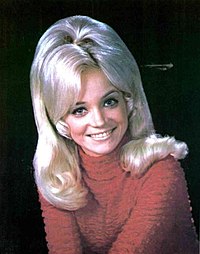
In 1971, Mandrell's single "This night My Infant's Coming Domicile" was her first to peak in the top 10 of the Billboard country songs chart.[18] It was followed in 1972 by a cover of Joe Tex's "Evidence Me", which made the superlative twenty on the same nautical chart.[18] [fifteen] At the same time, Mandrell started recording with country vocalist David Houston. Several of their recordings were released as singles and made the country charts in the U.s. and Canada. Their first single "Subsequently Closing Time" reached number six on the Billboard state survey and number four on Canada'due south RPM Land songs listing.[18] [23] Their duets made the charts several more times between 1970 and 1974, including "I Love You lot, I Dearest Yous" (1973), which climbed into the Billboard superlative 10 too.[xviii] Their recordings were released on a studio album titled A Perfect Friction match.[xv]
Critics and writers took notice of Mandrell's fusion of country music with R&B–soul. Author Kurt Wolff of Country Music: The Crude Guide described her early chart records as "colorful, spirited country soul". Wolff further explained, "The songs weren't exactly all roots and downhome twang, merely they were certainly closer to the ground (and the soul) than whatever of her after, more than suburban material."[17] Mary A. Bufwack and Robert Chiliad. Oermann highlighted Mandrell's country–soul mix in their 2003 book: "[Mandrell'due south commitment] gives her vocals a hoarse, urgent quality that she put to practiced utilise on 'bluish-eyed soul' versions of R&B songs," they noted.[24]
In reviewing a Columbia compilation, AllMusic'due south Greg Adams stated that her early on piece of work was "some of the best recordings [Barbara Mandrell] e'er fabricated."[25] Some critics establish that Mandrell's Columbia material lacked individuality and at times seemed closer resemble that of other Columbia artists. "Sometimes, it seems every bit if Sherrill isn't quite sure what to practice with Mandrell. He keeps her away from annihilation that could exist construed as a skillful fit for Tammy Wynette, and when the state does turn toward the direct-ahead, it'due south still soft; Merle Haggard'due south 'Today I Started Loving You Over again' doesn't conduct resignation in Barbara's hands, only reassurance," Stephen Thomas Erlewine commented on ane of her early on LP's.[26]
In 1973, Columbia issued what was considered Mandrell's "quantum"[24] record called "The Midnight Oil". The song told the story of a wife having an affair and lying to her hubby nigh the state of affairs.[24] [viii] The single became her second solo top ten hitting, reaching number vii on the Billboard country chart and number five on the RPM country nautical chart.[18] [23] Its respective studio album of the same proper noun reached the number 8 position on the Billboard country LP'due south chart.[27] In 1974, she reached the top 20 on the country chart with "This Time I Almost Made It",[xviii] which followed a similar country–soul style as her previous textile.[26] Mandrell later reflected to Biography nigh the lack of confidence she felt showcased her Columbia textile: "There have been many times when I thought other people might be better singers or better musicians or prettier than me, but then I would hear Daddy's vocalisation telling me to never say never, and I would find a way to squeeze an extra inch or ii out of what God had given me."[5] In 1975, she left Columbia's roster.[15]
1975–1986: Country–popular crossover and career acme [edit]
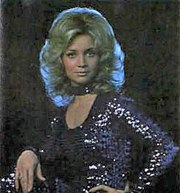
Barbara Mandrell in Billboard mag, 1977.
In 1975, Mandrell signed a recording contract with ABC–Dot (it was afterward bought by MCA Records). With producer Tom Collins, Mandrell incorporated a popular product that broadened her appeal with listeners.[8] [15] Her start ABC–Dot single was 1975's "Standing Room", which was her first elevation five Billboard country song.[18] [iv] It was followed past the peak twenty songs "That'southward What Friends Are For" and "Midnight Angel".[18] Collins also incorporated R&B elements into her repertoire, which further elevated her commercial success.[15] Her R&B covers of Denise LaSalle'south "Married But Not to Each Other" and Shirley Brownish's "Woman to Woman"[19] made the American and Canadian country song top 5 in 1977.[eighteen] "Woman to Woman" was also her first enter the Billboard Hot 100.[28] These recordings appeared on her sixth and seventh studio albums, which were also issued in 1977.[29] [xxx]
Mandrell reached her commercial zenith in the late 1970s with songs nigh adultery and cheating.[24] [four] [31] In 1978, "Sleeping Single in a Double Bed" was her first unmarried to reach the number one spot on the Billboard and RPM country charts.[eighteen] [23] It was followed in 1979 past a embrace of Luther Ingram's R&B hit "(If Loving You Is Wrong) I Don't Desire to Be Right".[19] It also topped the North American state charts[24] and crossed over into the summit twoscore of the Billboard Hot 100 and Canadian pop songs chart.[32] [28] On Billboard's adult contemporary survey, the unmarried reached the top ten.[33] Both tracks appeared on Mandrell'south superlative ten Billboard country album Moods (1978). Her 1979 anthology Simply for the Record was also a meridian 10 Billboard LP.[27] Just for the Record spawned the land–popular crossover singles "Fooled by a Feeling" and "Years".[28] [33]
Now at her career summit, Mandrell became a headlining concert act.[34] Her concert productions included choreography, costume changes and featured Mandrell on multiple musical instruments.[35] One of her headlining performances was turned into a cablevision television special called The Lady Is a Gnaw.[36] She as well appeared on national telly programs[34] and won the Country Music Clan'south 1979 Female person Vocalist of the Year accolade.[37] Between 1980 and 1982, she and her siblings co-hosted the NBC television series Barbara Mandrell & the Mandrell Sisters.[four] It helped Mandrell become the starting time performer to win back–to–back Entertainer of the Yr awards from the Country Music Association in both 1980 and 1981.[37] [35] Mandrell'south recordings continued having commercial success as well. She had top ten land singles with 1980's "Crackers" and "The All-time of Strangers".[34] In 1982, MCA issued her first live album,[38] which charted the Billboard country albums top five[27] and certified gold in sales from the United States.[39] The disc included a rails about staying close to country roots called "I Was Country When Country Wasn't Cool".[8] Released as a single, information technology was her fourth number 1 song on the Billboard country chart.[18]
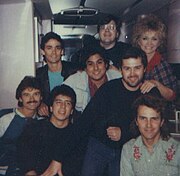
Mandrell on bout with her band, 1986.
Mandrell's commercial momentum connected through the early 1980s.[40] Her twelfth studio album ...In Black & White reached number 7 on the country albums list. It was followed past her fourteenth studio record Spun Gold (1983), which climbed to number five on the same list.[27] Both discs spawned the number one singles "'Till You're Gone" and "One of a Kind Pair of Fools". Also included were the summit ten recordings "Operator, Long Distance Please" and "In Times Like These".[xviii] [23] Mandrell's 1984 anthology was too a tiptop ten Billboard disc[27] and featured the top 5 singles "Just a Lonely Eye Knows" and "Happy Birthday Beloved Heartache".[eighteen] Mandrell's popularity immune her to record an anthology of gospel music in 1982 titled He Set up My Life to Music.[41] The projection brought Mandrell her first Grammy awards.[42] She also collaborated on several duets with Lee Greenwood in 1984.[43] The duets were issued on their 1984 studio album Meant for Each Other,[44] which featured the top five country single "To Me".[xviii]
Despite her popularity and commercial appeal, Mandrell's early–1980s music received mixed reviews. Writer Kurt Wolff plant that her 1980s recordings exemplified "a weak attempt to maintain her roots" featuring "garnish productions" that went "head-first into schmaltz".[8] In reviewing her 1983 anthology, critic Greg Adams commented, "Spun Gold contains some bizarre collisions of country music'south traditional working-class perspective with disco-era glitz."[45] Meanwhile, writers Mary A. Bufwack and Robert One thousand. Oermann described her early 1980s singles as "powerful heartache songs" whose themes centered around "enduring financial hardship" and "proudhoped-for country canticle[s]".[xl]
In tardily 1984, Mandrell and her children were involved in a car accident that halted her career for a year.[4] [43] The accident made Mandrell reconsider her professional choices altogether.[40] "I never thought I would always sing again or exist Barbara Mandrell over again, or any of that," she later told CNN.[46] She eventually returned to the recording studio in May 1985,[47] which resulted in the 1985 top ten country single "At that place's No Dearest in Tennessee". It appeared on Mandrell's Greatest Hits compilation, which was besides issued in 1985.[48] She returned to the stage for the first fourth dimension in 1986 at the Los Angeles Universal Amphitheatre, with Dolly Parton serving every bit her opening act.[40] Her next studio album Go to the Heart (1985)[49] spawned the tiptop ten Billboard songs "Fast Lanes and Land Roads" and "Angel in Your Arms".[xviii] Her final album for MCA appeared in 1986 titled Moments.[50] It spawned the tiptop ten land song "No Ane Mends a Broken Eye Like You".[23] [xviii]
1987–1997: Later recordings, career deadening–downwards and retirement [edit]
In 1987, Mandrell signed a new recording contract with EMI America. Her first album with the label was the studio offering Sure Feels Good (1987).[51] The disc reached number 24 on the Billboard country albums survey.[27] United Press International positively commented that, "Mandrell should be proud of this effort which should put her back on top of the charts."[51] Yet, of its three singles merely "Child Support" reached the elevation 20 of the North American country charts.[18] [23] Mandrell's hereafter singles and albums reached progressively–lower chart positions as a new group of traditionally–oriented country artists began having more commercial success.[iv] [36] Even so, Mandrell continued touring and remained a pop concert attraction through the 1980s and 1990s.[48] [36]
Mandrell signed with Capitol Records in late 1987.[40] Her first Capitol single was a cover of Ray Price's "I Wish I Could Fall in Dear Today", which reached the pinnacle 5 of the American and Canadian singles charts.[18] [23] Information technology was included on her nineteenth studio disc I'll Be Your Jukebox Tonight (1988). The project featured a traditional land sound and included production credits for the first fourth dimension from Fred Foster.[52] It also spawned the superlative twenty unmarried "My Train of Thought" (1989) and the charting song "Mirror, Mirror". Both songs were her concluding singles to chart in the United states.[18] Mandrell remained with Capitol until 1991. Her side by side 2 Capitol discs were both issued in 1990: Morning Sunday [53] and No Nonsense (distributed through Liberty).[54] For the latter album, Mandrell signed a commercial deal with the No Nonsense panty hose brand.[40] Her final Capitol–Liberty project was issued in 1991 called Key's in the Mailbox.[55] Mandrell'south Capitol recordings found positive reviews from critics. Mary. A Bufwack and Robert K. Oermann institute the songs to showcase "strong female lyrics",[twoscore] while Nib Carpenter said her 1991 album exemplified "Heartful soul and contemporary state."[56]
Mandrell continued making alive operation appearances on network telly. She also remained a popular act on the Grand Ole Opry, including their televised portion of the plan.[48] Mandrell as well continued recording and releasing new fabric. In 1994, the New York label Directly Records released 2 albums of her music. The studio anthology projects were marketed exclusively through telly and appeared on networks such equally TNN.[57] That year, the label issued Acoustic Attitude, which was an album of re-recordings.[58] The characterization also issued an album of new textile that year titled It Works for Me.[59] The album was reissued on Razor & Tie in 1997, which Mandrell temporarily signed a contract with that year.[60]
Also in 1997, Mandrell appear her retirement from touring, recording and performing. In an interview with Billboard, Mandrell explained that she chose to retire then she could focus on an full–fourth dimension interim career. She gave her final musical performance in October 1997 at the Grand Ole Opry firm. Her last concert was aired on network television.[61] Titled Barbara Mandrell and the Exercise-Rites: The Last Dance, premiered on TNN in late 1997.[9] [v] Later on her retirement, Mandrell sold all of her musical instruments. She now spends time on her family and domestic responsibilities.[62]
Acting career [edit]
1978–1983: Early roles and tv set diverseness series [edit]
Mandrell began gaining regular exposure on national tv programs.[34] [63] Her idiot box credits from this period included appearances on The Tonight Show, American Bandstand and Bob Promise entertainment specials.[15] Among the highlights was an advent on a 1979 episode of The Rockford Files [64] and co-hosting the 1979 Academy of Country Music Awards.[34] In late 1979 she played herself in the vacation program Skinflint: A Christmas Carol aslope several other land artists of the era. The special was a southern American have on the original story of the same name. Fred Guida gave the plan a negative review in his book A Christmas Carol and Its Adaptations: "Unfortunately, Skinflint fails to live upwards to its interesting premise, and the result is one of the lamest Carol variations to date."[65]
Mandrell was given multiple offers from the NBC network to host her own syndicated show. Nevertheless, she routinely turned it downwards. One day, NBC producer Marty Krofft was shown a wallet-sized photo of Mandrell and her sisters playing different musical instruments. This prompted Krofft to contact Mandrell about offering her a plan that she could co–host with her sisters. From his encouragement, she eventually agreed to host a show on his network.[66] In 1980, she was signed by NBC to host a national tv variety series. Titled Barbara Mandrell & the Mandrell Sisters, the evidence was hosted by Mandrell forth with her two sisters Irlene and Louise.[34] [35]
Mandrell learned choreography for the show and was routinely featured playing multiple musical instruments.[67] In add-on, the Mandrell sisters performed a series of comedy sketches. In their book The Complete Directory to Prime Fourth dimension Network and Cable TV Shows, authors Tim Brooks and Earle F. Marsh noted that Barbara often portrayed the "serious, pushy sister" while Irlene was portrayed equally the "sexy, vain one".[68] Mandrell oft had to push button back against NBC executives who insisted that the show feature hay barrels and other features of traditional country-western shows. "They wait you to exist barefoot and ignorant," Mandrell commented in 2003.[35] During its top, it was estimated that the prove attracted roughly 40 million viewers per calendar week.[67] For her piece of work, Mandrell was nominated for Best Extra in a Television Musical or One-act Series by the Gilded Globe Awards.[69]

Mandrell continued entertaining into the late 1980s. Here, she appears with Bob Hope and Brooke Shields for a military engagement (1987).
Despite the NBC show's success, the constant workload (along with a focus on her music career) caused Mandrell to suffer from exhaustion.[seventy] [31] She often had to take extra naps on her tour charabanc parked adjacent to the television studio. She also had to accept Cortisone shots before show tapings so that her vocal chords had less strain.[71] She was urged to quit the bear witness by physicians who warned that she would ultimately suffer from permanent vocal damage.[35] [71] In 1982, Mandrell appear the plan would end after a 2-year run on NBC.[68] "I'1000 the but person that I know of that has ever left a television series with a five year contract," she later commented.[35]
1984–2000: Later television roles [edit]
Mandrell continued acting following her bear witness's counterfoil. In 1984, Mandrell debuted in her first television film titled Burning Rage.[40] Mandrell played the chief part of a geologist who investigates coal mining fires underneath a boondocks in Tennessee.[72] Joe Dark-brown of The Washington Post chosen the film, "an overheated championship for what amounts to a lukewarm drama most a natural phenomenon and its effect on a small-scale town." He concluded by commenting on Mandrell'southward acting operation: "Every bit an actress, Mandrell is likable and natural, but she has little to do here but walk effectually looking concerned when she'southward not getting into tepid clinches with [Tom] Wopat".[73] Following her 1984 car accident, a television special of Mandrell'due south was aired on CBS titled Barbara Mandrell–Something Special.[48]
She also made appearances on talk shows and network programs during the belatedly 1980s and early 1990s. She as well was featured in several television receiver commercials for food products.[48] In the early on 1990s, she portrayed a character on the television bear witness Empty Nest.[74] In 1994, Mandrell played a invitee role in an episode of ABC's The Commish. The Baltimore Sun described her as playing "a less sympathetic function than usual" in their description of the episode.[75]
During the mid 1990s, Mandrell also played roles on the shows Touched by an Angel, Dr. Quinn Medicine Woman and Baywatch.[76] In 1997, Mandrell gave up her music career to focus on acting total-fourth dimension.[36] She signed with the Creative Artists Agency, which helped her learn more tv set roles. She appeared equally a recurring character in the soap opera Sunset Beach.[61] In 1999, Mandrell played the mother of a deceased son who finds disharmonize with his "controlling girlfriend". Titled The Incorrect Daughter, the goggle box filmed aired on NBC that year.[77] Among Mandrell's final acting credits was 2000's fabricated for telly film Stolen from the Centre.[78]
Artistry [edit]
Musicianship [edit]
In improver to singing, Mandrell is also known for playing multiple instruments.[4] [79] In her teenage years, she was nicknamed "The Princess of Steel" for get a adept steel guitar player.[i] [80] In a 2006 interview with CMT, Mandrell explained that she is "skillful" on the steel guitar, alto saxophone, dobro, five-string banjo, and bass. She as well said that she can play the guitar and mandolin "if necessary".[eleven] PBS described Mandrell as "a true prodigy" in reference to her musicianship.[ane] News & Tape plant that Mandrell's musicianship tin can also exist found in her alive shows: "Those hours are packed with aerobics, every bit Mandrell dances and prances across the stage, playing several musical instruments and clowning with her Practice-Rites band."[81] In reviewing a concert, The Morning time Call explained, "No Mandrell show would exist complete without a sit-in of the vocaliser's musical virtuosity. Playing a mean saxophone and banjo during the course of the evening, Mandrell proved herself to be a talented musician."[82]
Musical styles and phonation [edit]
Mandrell's musical style embeds country music[four] with country–pop,[1] R&B–soul,[83] and gospel.[41] Jason Ankeny of AllMusic establish that the virtually pop era of her career (late 1970s and early 1980s) had a "glitzier, more pop-influenced" sound.[4] Kurt Wolff highlighted a similar theme in his book State Music: The Rough Guide: "[Tom] Collins churned out frightfully slick and garnish productions, simply Mandrell thrived in her new surround."[8] Hunter Kelly of Rolling Stone explained that when Mandrell began incorporating R&B sounds into her style that her career "really kicked into overdrive". Mandrell further explained her reasoning behind incorporating R&B: "To me, country music and R&B music accept a lot of similarities, but the i thing that I retrieve is the virtually of import is both genres, just direct ahead, they're telling you. They're not making up a story just because it rhymes nicely."[83]
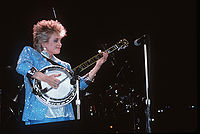
Mandrell was known for playing multiple musical instruments in her live shows. Hither, she is seen playing the banjo, 1986.
Writers found that Mandrell had her greatest commercial success with songs that incorporated subjects of cheating. Mary A. Bufwack and Robert G. Oermann found this to be especially evident after she transitioned to her second tape label: "Barbara continued to smolder in sin subsequently moving to the ABC/MCA Records fold in 1975."[84] Kurt Wolff found a like theme with cheating fabric: "The subjects of many of Mandrell'south songs were also racy for the fourth dimension, dealing openly with such topics as animalism, sexual loneliness, and late dark-dark love trysts." Wolff further commented, "What'south ironic about her subject area matter is that Mandrell herself–a devout Christian, female parent and wife– always maintained an impeccably clean, family–oriented profile."[viii] "I've recorded a lot of cheating songs, but at that place were a lot of adulterous songs I turned down. It depends on the lyrics...God loves prostitutes too," Mandrell further commented.[24]
Mandrell's singing voice has also been the subject field of word amongst writers and critics. Mary Bufwack and Robert Oermann commented that her habit of smoking cigarettes made her voice stand out: "Barbara is a heavy smoker, and this gives her vocals a hoarse, urgent quality that she put to good use on 'blueish-eyed soul' versions of R&B songs," they commented in 2003.[24] In 1982, The Washington Postal service highlighted Mandrell's singing in a review of her concert performance: "At other times the gritty edges of her husky voice crackled with R&B flourishes and gospel fervor. It was an impressive display."[66] In 1984, The Oklahoman commented on her live singing besides: "She can perform virtually anything brusk of yard opera in fact, if she took a mind to, she probably could practice that too (after all, Linda Ronstadt did!)."[85]
Legacy [edit]
Mandrell has been widely considered among country music'southward most successful artists and all–around entertainers.[86] [i] [4] "Perhaps the toughest soldier in the female army that invaded the land charts in the 1970s, Barbara could outwork, outperform, out-talk, and out-grinning near anyone in prove business," wrote Mary A. Bufwack and Robert K. Oermann.[87] Jason Ankeny of AllMusic commented in a similar fashion: "Thanks to a string of hit singles and a popular television diverseness series, singer Barbara Mandrell was arguably the biggest female star in country music in the late '70s and early '80s."[4] Paul Kingsbury, Michael McCall and John Rumble explained that Mandrell, "took her soul–country manner to the biggest showrooms of Las Vegas, ruled the country charts during the late 1970s and early 1980s, starred on network Tv set, and told her story in 1 of country'due south best–selling autobiographies".[67]

Her influence on future artists has as well shaped her legacy. Mandrell has been credited as an influence for Terri Clark,[88] Reba McEntire,[89] and Carly Pearce.[90] McEntire thanked Mandrell in 2009 and spoke about her influence: "I thank you for the things that you lot've taught me, not only musically, only spiritually...And I will always treasure our relationship with all my heart."[91] In 2006, several artists re-recorded several of Mandrell'due south most popular singles in tribute to her career. The project was titled She Was Country When Country Wasn't Cool: A Tribute to Barbara Mandrell. Information technology featured of remakes of her songs performed by contemporary country performers such was Kenny Chesney, Sara Evans and LeAnn Rimes.[eleven]
Mandrell has been only one of a few women to win the Country Music Association's Entertainer of the Year award.[92] She was also the first individual to win the laurels in back to dorsum years (1980 and 1981).[37] [1] In 2005, she received the Triple Crown honor from the Academy of Country Music for winning three major awards from the association. She is just one of several people to have since won the award.[93] In 2009, Mandrell was inducted into the Country Music Hall of Fame and Museum.[9] She was inducted that twelvemonth along with Roy Clark and Charlie McCoy.[91] Her induction was historic that year at the Country Music Association Awards where Mandrell gave a voice communication to thank the manufacture.[94]
Mandrell'south legacy was further cemented she released her 1990 autobiography chosen Get to the Heart: My Story (co-written with writer George Vecsey titled).[95] In 1997, the book was turned into a television movie titled Get to the Heart: The Barbara Mandrell Story. She was portrayed in the film by television set extra Maureen McCormick. Mandrell briefly made a cameo appearance at the first and terminate of the film.[96]
In 2020, American DJ and producer Dave Audé partnered with Mandrell to remix her 1978 vocal "Sleeping Unmarried in a Double Bed". Rolling Stone explained that the vocal was remixed equally "the first step in a new effort to bring Barbara Mandrell'due south music into the digital age."[83] It was followed by all of Mandrell's LP's existence reissued to digital and streaming sites. Her original Columbia, ABC–Dot, MCA and Capitol albums were all re–released through various digital platforms.[97]
Personal life [edit]
Marriage and family life [edit]
Mandrell has been married to former musician and Navy pilot Ken Dudney since 1967.[7] [98] Dudney was originally hired as the drummer for Mandrell's family band.[7] The pair met when she was 14 and he was 21. Dudney was engaged to another woman at the time. However, he broke off the engagement afterwards having feelings for Mandrell.[99] In 2003, Mandrell commented how her excitement marry Dudney: "I'd dated him since I was fourteen and I only couldn't look to graduate high school so I could exist Mrs. Ken Dudney."[100] The pair officially wednesday in 1967.[98] At the time of their matrimony, Dudney gave upwardly his career as a Navy pilot to help further his wife's career.[16] The couple later welcomed their first child Matthew in 1970, followed by daughter Jamie in 1976.[101] Mandrell gave birth in 1985 to a tertiary child, Nathan.[102]
In 1988, Mandrell and her family built a log cabin mansion called the Fontanel Mansion.[103] The home consisted of half-dozen bedrooms, 13 bathrooms, ii kitchens, five fire places and a helicopter landing pad. It has been considered to exist the largest log cabin abode in the world.[104] [105] Mandrell sold the home in 2002 in order to downsize. The habitation was auctioned.[105] Information technology has since been turned into a tourist attraction with a eating place, a hotel, an outdoor music venue, and an indoor shooting range.[106] [107] Her girl, Jaime, was the homo resources manager of the mansion until Feb 2017. She then began a new career with a company that works to place people with addiction bug into appropriate rehabilitation facilities.[106] [108]
Car accident [edit]

In 1984, Mandrell and her ii children were struck head-on by an oncoming machine in Nashville, Tennessee. At the fourth dimension of the blow, Mandrell was driving a Jaguar XJ sedan.
In September 1984, Mandrell and her two children were involved in a head-on car collision near their Nashville home.[109] The driver of the other auto in the accident (19-year-sometime higher student Mark White) was killed instantly.[110] The law report stated that White's motorcar had crossed the center line of the route, causing a head-on collision with Mandrell's Jaguar XJ.[111] [112] Both of Mandrell's children but suffered minor injuries and were released from the infirmary before long following their arrival.[109] Mandrell herself suffered critical injuries from the blow.[109] These injuries included a broken femur, shattered ankle, injured knee and a concussion that left temporary brain damage.[111]
Mandrell's injuries from the accident resulted in her suffering from pain throughout her torso for months.[111] Much of the physical pain she suffered came from articulatio genus injuries. "You tin can't say she`s in terrible hurting all the fourth dimension if the hurting she'due south in is the kind where she`s trying to exceed what that knee will do, trying to brand it do its full matter once more. Every twenty-four hours she`due south trying to make it exceed what it did the day before and then she tin finally become information technology back to full chapters," said father Irby Mandrell to the Chicago Tribune.[113]
Due to Mandrell's head injuries, she had a temporary shift in personality and experienced memory loss.[111] "I would refer to myself in the third person: 'That was her' or 'She did that' or 'You lot should have asked her. I tin can't do that'," she told The 700 Club.[114] Mandrell'south injuries took over a twelvemonth to fully recover.[36] In an interview with CMT, she explained that her head injury took almost three years to fully recover. She besides explained that she still suffers from pain in her talocrural joint.[11] Mandrell credited wearing a seat belt to saving her and her children'due south lives.[115] She campaigned and filmed television commercials that advocated for the employ of seat belts in cars.[116] She also campaigned for arthritis and organ donation.[111] She was likewise made the honorary chairman of the National Highway Traffic Safety Assistants in 1985.[117]
Almost a year afterwards, Mandrell sued the White family unit for $10.three million in amercement. According to Tennessee state police, Mandrell had to sue the family of the driver for insurance purposes.[118] [112] Her legal team contacted the White family unit in an try to inform them that Mandrell did not want coin from them but instead needed to do information technology for legal purposes. The lawsuit created controversy among Mandrell'due south fans. "I'm non blaming the public...I would have felt the fashion they felt," she commented in 1995.[119] [118]
Discography [edit]
- Studio albums
- Care for Him Right (1971)
- A Perfect Match (with David Houston) (1972)
- The Midnight Oil (1973)
- This Time I Almost Made Information technology (1974)
- This Is Barbara Mandrell (1976)
- Midnight Affections (1976)
- Lovers, Friends and Strangers (1977)
- Dearest'due south Ups and Downs (1977)
- Moods (1978)
- But for the Record (1979)
- Love Is Fair (1980)
- ...In Black & White (1982)
- He Set My Life to Music (1982)
- Spun Gold (1983)
- Clean Cut (1984)
- Meant for Each Other (with Lee Greenwood) (1984)
- Christmas at Our Business firm (1984)
- Go to the Heart (1985)
- Moments (1986)
- Sure Feels Skillful (1987)
- I'll Be Your Jukebox This night (1988)
- Precious Memories (1989)
- Morning time Sun (1990)
- No Nonsense (1990)
- Central's in the Mailbox (1991)
- Acoustic Mental attitude (1994)
- It Works for Me (1994)
Awards and nominations [edit]
Barbara Mandrell has won many several awards for her work as an entertainer. This includes half dozen accolades from the Academy of Land Music,[21] four from the Country Music Association[37] and ii from the Grammy Awards.[42]
Filmography [edit]
Books [edit]
- Get to the Centre: My Story (with George Vecsey) (1990)[95] [130]
References [edit]
Footnotes [edit]
- ^ a b c d eastward f Burns, Ken. "Barbara Mandrell Biography". PBS . Retrieved 17 January 2022.
- ^ "Barbara Mandrell chart history (Country Songs)". Billboard . Retrieved 24 Jan 2022.
- ^ a b Wolff, p. 443. sfn error: no target: CITEREFWolff (help)
- ^ a b c d e f g h i j k l m due north o Ankeny, Jason. "Barbara Mandrell: Biography". AllMusic . Retrieved 21 January 2022.
- ^ a b c "Barbara Mandrell – Age, songs, & husband – Biography". Biography . Retrieved 21 January 2022.
- ^ a b c McConnico, Patricia (October 1999). "Barbara Mandrell Barbara Mandrell'southward Corpus Christi harmonies". Texas Monthly . Retrieved 21 Jan 2022.
- ^ a b c d east f m h Oermann & Bufwack 2003, p. 339.
- ^ a b c d e f g h Wolff 2000, p. 443.
- ^ a b c d e f k h Oermann, Robert K. "Barbara Mandrell: Artist Bio". State Music Hall of Fame and Museum . Retrieved 21 January 2022.
- ^ a b c Stambler & Landon 2000, p. 379.
- ^ a b c d e "twenty Questions With Barbara Mandrell". Country Music Idiot box. October 18, 2006. Retrieved 18 Jan 2022.
- ^ Snapp, Lauryn. "Barbara Mandrell Remembers Having Slumber Parties With Patsy Cline". iHeartRadio . Retrieved 21 January 2022.
- ^ a b c Stambler & Landon 2000, p. 279-280.
- ^ "2018 Miss Oceanside Scholarship Pageant-April xiv". Oside News. 3 Apr 2018. Retrieved 21 Jan 2022.
- ^ a b c d e f g h i j k Stambler & Landon 2000, p. 280.
- ^ a b c Oermann & Bufwack 2003, p. 340.
- ^ a b Wolff 200, p. 443. sfn fault: no target: CITEREFWolff200 (assistance)
- ^ a b c d e f thousand h i j k l thousand north o p q r s t u Whitburn, Joel (2008). Hot Country Songs 1944 to 2008. Record Enquiry, Inc. ISBN978-0-89820-177-two.
- ^ a b c Whitburn, Joel (2004). Pinnacle R&B/Hip-Hop Singles: 1942-2004. Record Enquiry. p. 250.
- ^ Mandrell, Barbara (Oct 4, 1971). "Care for Him Right (LP Liner Notes and Album Information)". Columbia Records. 30967.
- ^ a b "University of Land Music (Barbara Mandrell)". ACM Country . Retrieved February 26, 2021.
- ^ "Barbara Mandrell". One thousand Ole Opry . Retrieved 22 Jan 2022.
- ^ a b c d e f yard "Search results for "Barbara Mandrell" under Country Songs". RPM . Retrieved 16 Jan 2022.
- ^ a b c d e f g Bufwack & Oermann 2003, p. 340. sfn error: no target: CITEREFBufwackOermann2003 (help)
- ^ Adams, Greg. "Super Hits: Barbara Mandrell: Songs, reviews, credits". AllMusic . Retrieved 22 January 2022.
- ^ a b Erlewine, Stephen Thomas. "This Time I Virtually Made It: Barbara Mandrell: Songs, reviews, credits". AllMusic . Retrieved 22 January 2022.
- ^ a b c d eastward f "Barbara Mandrell chart history (State Albums)". Billboard . Retrieved 22 January 2022.
- ^ a b c "Barbara Mandrell chart history (Hot 100)". Billboard . Retrieved 24 January 2022.
- ^ Mandrell, Barbara (1977). "Lovers, Friends and Strangers (LP Album Data)". ABC Records/Dot Records. 673.
- ^ Mandrell, Barbara (1977). "Lovers, Friends and Strangers (LP Album Data)". ABC Records. 2098.
- ^ a b Wolff 2000, p. 442-443.
- ^ "Search results for "Barbara Mandrell" under Top Singles". RPM . Retrieved 16 Jan 2022.
- ^ a b "Barbara Mandrell chart history (Adult Contemporary songs)". Billboard . Retrieved 24 January 2022.
- ^ a b c d due east f Stambler & Landon 2000, p. 280-281.
- ^ a b c d e f Bufwack & Oermann 2003, p. 341. sfn error: no target: CITEREFBufwackOermann2003 (help)
- ^ a b c d eastward Wolff 2000, p. 444.
- ^ a b c d "CMA Awards By Winners & Nominees (Barbara Mandrell)". CMA Awards . Retrieved February 26, 2021.
- ^ Mandrell, Barbara (1981). "Barbara Mandrell Live (Cassette Liner Notes and Album Data)". MCA Records. MCAC-1697.
- ^ "Barbara Mandrell Alive Gold & Platinum". Recording Industry Association of America . Retrieved 24 January 2022.
- ^ a b c d e f grand h Bufwack & Oermann 2003, p. 342. sfn mistake: no target: CITEREFBufwackOermann2003 (help)
- ^ a b ""He Fix My Life to Music": Barbara Mandrell's First Gospel Album". Billboard. October two, 1982. Retrieved 24 January 2022.
- ^ a b "Barbara Mandrell - Artist - GRAMMYs". GRAMMY. Nov 23, 2020. Retrieved February 26, 2021.
- ^ a b Stambler & Landon 2000, p. 281.
- ^ Greenwood, Lee; Mandrell, Barbara (1984). "Meant for Each Other (CD Data)". MCA Records. MCAD-31231.
- ^ Adams, Greg. "Spun Gold: Barbara Mandrell: Songs, reviews, credits". AllMusic . Retrieved 24 January 2022.
- ^ "Encore Presentation: Country Music Superstars". CNN. December 31, 2005. Retrieved 24 January 2022.
- ^ Beck, Marilyn (May 25, 1985). "BARBARBA MANDRELL IS BACK RECORDING". Chicago Tribune . Retrieved 24 January 2022.
- ^ a b c d eastward Stambler & Landon 2000, p. 282.
- ^ Mandrell, Barbara (1985). "Become to the Middle (LP Album Information)". MCA Records. 5619.
- ^ Mandrell, Barbara (1986). "Moments (LP Album Information)". MCA Records. 5769.
- ^ a b "On the Tape". United Press International. September iv, 1987. Retrieved 24 January 2022.
- ^ Mandrell, Barbara (1988). "I'll Be Your Jukebox This evening (CD Liner Notes and Information)". Capitol Records. 90416.
- ^ Mandrell, Barbara (1990). "Morning Sun (CD Liner Notes and Information)". Capitol Records. C2-91977.
- ^ Mandrell, Barbara (1990). "No Nonsense (CD Liner Notes and Data)". Freedom Records. 94426.
- ^ Mandrell, Barbara (1991). "Key'due south in the Mailbox (CD Liner Notes and Information)". Liberty Records. C2-96794.
- ^ Carpenter, Bill. "Key's in the Mailbox: Barbara Mandrell". AllMusic . Retrieved 24 January 2022.
- ^ Morris, Edward (Apr xvi, 1994). "Nashville Scene". Billboard. p. 38. Retrieved 24 Jan 2022.
- ^ Mandrell, Barbara (1994). "Audio-visual Attitude (CD Liner Notes and Album Information)". Direct Records. DRD-002.
- ^ Mandrell, Barbara (1994). "It Works for Me (CD Liner Notes and Album Information)". Direct Records. DRD-004.
- ^ Mandrell, Barbara (1997). "It Works for Me (CD Liner Notes and Anthology Data)". Razor & Tie. RT-2828-2.
- ^ a b Flippo, Chet (October 25, 1997). "Mandrell Readies Her 'Concluding Trip the light fantastic'". Billboard. p. one. Retrieved 24 January 2022.
- ^ Dukes, Billy. "The Secret History of Why Barbara Mandrell Seemingly Vanished". Gustation of Country . Retrieved 24 January 2022.
- ^ Bufwack & Oermann 2003, p. 341-343. sfn fault: no target: CITEREFBufwackOermann2003 (aid)
- ^ a b Erickson, Hal. "The Rockford Files: Dear Is the Word: Synoposis". AllMovie . Retrieved 29 Jan 2022.
- ^ Guida, Fred (2006). A Christmas Carol and Its Adaptations A Disquisitional Examination of Dickens'due south Story and Its Productions on Screen and Television. McFarland, Incorporated Publishers. p. 205. ISBN9780786428403.
- ^ a b Harrington, Richard (Baronial thirteen, 1982). "Barbara Mandrell". The Washington Postal service . Retrieved 30 January 2022.
- ^ a b c Kingsbury, Paul; McCall, Michael; Rumble, John (1998). The Encyclopedia of Country Music The Ultimate Guide to the Music. Oxford Academy Press. p. 324. ISBN9780199770557.
- ^ a b c Brooks, Tim; Marsh, Earle F. (2009). The Consummate Directory to Prime Time Network and Cable TV Shows, 1946-Nowadays. Random Firm Publishing Group. ISBN9780307483201.
- ^ "Barbara Mandrell: Golden Globes". Golden Earth Awards . Retrieved 29 January 2022.
- ^ Bufwack & Oermann 2003, p. 339-341. sfn mistake: no target: CITEREFBufwackOermann2003 (help)
- ^ a b Schmitt, Brad. "Barbara Mandrell, her sisters to reunite for fur babies". The Tennessean . Retrieved 29 January 2022.
- ^ a b "Burning Rage (1984)". Turner Archetype Movies . Retrieved 29 January 2022.
- ^ Brown, Joe (September 21, 1984). "'Rage': Coal-Fired Dissidence". The Washington Post . Retrieved 29 Jan 2022.
- ^ a b "Empty Nest: Gilded Globes". Golden World Awards . Retrieved 29 January 2022.
- ^ a b Bianculli, David (Nov 12, 1994). "R.E.M. on 'SNL': reason to lose sleep". The Baltimore Sun . Retrieved 29 January 2022.
- ^ "Cheerio, MUSIC....HELLO, ACTING". Sun-Sentinel. Oct 25, 1997. Retrieved 29 January 2022.
- ^ a b Marill, Alvin H. (2005). Movies Made for Television, 1964-2004: 1990-1999. Scarecrow Printing. p. 580. ISBN978-0810851740.
- ^ a b "Stolen from the Heart (2000)". Turner Archetype Movies . Retrieved 29 January 2022.
- ^ Wolff 2000, p. 442-444.
- ^ Wolff 2000, p. 442.
- ^ "BARBARA MANDRELL KICKS UP HER HEELS". News & Record. June 10, 1995. Retrieved xxx January 2022.
- ^ Longsdorf, Amy (December 12, 1987). "BARBARA MANDRELL NEEDS TO SHED FLASH AND FOCUS ON POWERFUL Vox CONCERT REVIEW". The Morning time Call . Retrieved 30 January 2022.
- ^ a b c Kelly, Hunter (May 27, 2020). "How Barbara Mandrell'south 1978 Hit 'Sleeping Unmarried in a Double Bed' Got a Dance Remix". Rolling Stone . Retrieved 30 Jan 2022.
- ^ Bufwack & Oermann, p. 340. sfn error: no target: CITEREFBufwackOermann (assistance)
- ^ Hammett, Kate. "Mandrell concert crawly". The Oklahoman . Retrieved 30 January 2022.
- ^ Bufwack & Oermann 2003, p. 338-341. sfn error: no target: CITEREFBufwackOermann2003 (aid)
- ^ Bufwack & Oermann 2003, p. 338. sfn fault: no target: CITEREFBufwackOermann2003 (help)
- ^ Bonaguro, Alyssa (October 8, 2020). "Terri Clark Gets an Old-School Cheers Annotation from Barbara Mandrell". Country Music Television . Retrieved 5 Feb 2022.
- ^ Thompson, Gayle. "Reba McEntire Reflects on the Inspiration of Loretta Lynn, Dolly Parton and Others". popculture . Retrieved v February 2022.
- ^ Blackness, Lauren Jo. "Carly Pearce Shares Songs That Inspired 'Next Daughter' In Exclusive Playlist Takeover". Land Now . Retrieved 5 February 2022.
- ^ a b Morris, Edward (May xviii, 2009). "Barbara Mandrell, Roy Clark, Charlie McCoy Bring together Country Music Hall of Fame". Land Music Telly . Retrieved 5 Feb 2022.
- ^ Vinson, Christina. "Every CMA Awards Entertainer of the Twelvemonth Winner Ever". The Boot . Retrieved 5 February 2022.
- ^ Betts, Stephen 50. (August x, 2016). "Luke Bryan, Maren Morris to Perform at 2022 ACM Honors". Rolling Stone . Retrieved 5 February 2022.
- ^ Shelburne, Craig (November 17, 2009). "Barbara Mandrell Praises Contemporary Country Music". Land Music Boob tube . Retrieved v Feb 2022.
- ^ a b Hurst, Jack (September 28, 1990). "BARBARA MANDRELL'S LIFE: TRANSFORMED By NEAR-Expiry". Orlando Lookout . Retrieved 29 January 2022.
- ^ a b Patterson, Jim (September 26, 1997). "Barbara Mandrell bets her career on boob tube". Associated Press . Retrieved 5 February 2022.
- ^ Hollabaugh, Lorie (June i, 2020). "Barbara Mandrell Releases New Remix, Vinyl Album Collection". Music Row . Retrieved v Feb 2022.
- ^ a b Willistein, Paul (August 31, 1984). "BARBARA MANDRELL JUST WASN'T CUT OUT TO BE IN THE Audience". The Morn Call . Retrieved 17 January 2022.
- ^ Falk, Fredrik. "Barbara Mandrell met her husband when she was only 14: At present shares the secret to their happy and lasting relationship". Newsner . Retrieved 17 Jan 2022.
- ^ Oermann & Bufwack 2003, p. 339-340.
- ^ Oermann & Bufwack 2003, p. 341.
- ^ "Mandrell's 3rd Child Is a Boy". Los Angeles Times. September six, 1985. Retrieved 17 January 2022.
- ^ Kazek, Kelly. "Barbara Mandrell'south one-time log mansion is at present one of the area's biggest tourist draws". Its a Southern Matter . Retrieved 17 January 2022.
- ^ Sheckler Finch, Jackie (April xvi, 2011). "Travel: A visit to the largest log cabin in the world". Daily Journal . Retrieved 17 January 2022.
- ^ a b "Barbara Mandrell's Quaint Log Cabin". Forbes. May 17, 2002. Retrieved 17 Jan 2022.
- ^ a b Stivender, Knight (September 16, 2012). "Backside the scenes at Fontanel: Barbara Mandrell's former home finds new groove equally entertainment mecca". The Tennessean . Retrieved September three, 2015. [ expressionless link ]
- ^ Duke, Jan. "Fontanel Mansion: Exploring the Fontanel Mansion & Farm". About.com. Archived from the original on September vii, 2015. Retrieved September iii, 2015.
- ^ "Allow'southward Catch Upwardly: July 26, 2017". barbara-mandrell.com. Retrieved Feb 12, 2019.
- ^ a b c "Barbara Mandrell, 35, Vocalist, Injured in Fatal ii-Car Crash". The New York Times. September 12, 1984. Retrieved xviii Jan 2022.
- ^ Mandrell, Barbara. "Mandrell Injured in Auto Accident". NY Times. Archived from the original on 19 Apr 2015. Retrieved 9 April 2015.
- ^ a b c d e Oermann & Bufwack 2003, p. 342.
- ^ a b Lewis, Jim (14 September 1985). "Lawsuit puts Mandrell in hot water with fans". UPI . Retrieved 31 Jan 2021.
- ^ Hurst, Jack (January half dozen, 1985). "MANDRELL'Due south HEALING FINE, BUT THANKS TO DAD, SHE'South Still HIGH Contour". Chicago Tribune . Retrieved 18 January 2022.
- ^ Wilcox, Cheryl. "Barbara Mandrell: Sweetness Through Suffering". The 700 Club . Retrieved xviii January 2022.
- ^ Egler, Daniel; Franklin, Tim (May vi, 1985). "MANDRELL TO SING OUT SUPPORT FOR Belt LAW". Chicago Tribune . Retrieved 18 January 2022.
- ^ Wilker, Deborah (February 22, 1991). "TURNING POINT BARBARA MANDRELL HAS SURVIVED TRAGEDY TO Come Dorsum A STRONGER PERSON, SHE SAYS". Lord's day-Sentinel . Retrieved 18 Jan 2022.
- ^ Gayoso, Jay (Nov 24, 1985). "NATIONAL CAMPAIGN PUSHES SEAT-Belt USE". Sun-Sentinel . Retrieved xviii Jan 2022.
- ^ a b "Names in the News". Associated Press. September xiv, 1985. Retrieved xviii January 2022.
- ^ Hurst, Jack (July 27, 1995). "REHABBED CAREER". Chicago Tribune . Retrieved 18 January 2022.
- ^ Terrace, Vincent (2013). Telly Specials 5,336 Amusement Programs, 1936-2012, 2d Ed. McFarland, Inc. Publishers. p. 336. ISBN978-0786474448.
- ^ Terrace, Vincent (1985). Encyclopedia of Television Series, Pilots and Specials. New York Zoetrope. p. 31. ISBN978-0918432612.
- ^ Male monarch, Susan (1991). "DON REID: Giving Nashville Variety". The Los Angeles Times . Retrieved 5 February 2022.
- ^ "Putting the final touches on this 'Angel'-ic CBS series". The Oklahoman . Retrieved 5 February 2022.
- ^ "Dr. Quinn, Medicine Woman (All That Glitters, 1996)". AllMovie . Retrieved 5 February 2022.
- ^ Hurst, Jack (November 15, 1996). "WHAT'S UP WITH BARBARA AND ALL OF THOSE Picayune MANDRELLS?". Chicago Tribune . Retrieved 5 Feb 2022.
- ^ "BBC I: Diagnosis Murder". BBC One . Retrieved 5 February 2022.
- ^ "Entertainment Notes". Tulsa World. March 11, 1997. Retrieved v February 2022.
- ^ Leszczak, Bob (2018). Single Flavour Sitcoms of the 1990s A Complete Guide. McFarland, Inc. Publishers. p. 273. ISBN978-1476631981.
- ^ Carter, Brook. "What Happened to Barbara Mandrell? – 2022 Update". Gazette Review . Retrieved 5 February 2022.
- ^ Mandrell, Barbara; Vecsey, George (1990). Get to the Heart: My Story. New York, NY: Bantam Books. ISBN978-0553292435.
Books [edit]
- Stambler, Irwin; Landon, Grelun (2000). State Music: The Encyclopedia. St. Martin'southward Printing. ISBN9780312264871.
- Oermann, Robert 1000.; Bufwack, Mary A. (2003). Finding Her Voice: Women in State Music: 1800–2000 . Nashville, TN: The Country Music Press & Vanderbilt University Press. ISBN0-8265-1432-4.
- Wolff, Kurt (2000). Land Music: The Crude Guide. London: Penguin Books. ISBNone-85828-534-8.
External links [edit]
- Official website
- Fontanel
- Barbara Mandrell at IMDb
Source: https://en.wikipedia.org/wiki/Barbara_Mandrell
0 Response to "Barbara Mandell Today I Started Loving You Again"
Post a Comment